
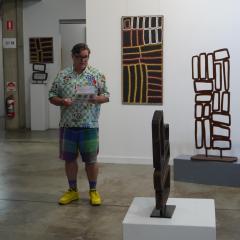
Michael Nelson Jagamara: Possum Stories & Remembering (Walala) Kumantjayi Tjapaltjarri
FireWorks Gallery Opening Saturday 17 October 2026 - Notes from Simon Wright
It’s a great honour of mine to have met and worked with Jagamara and Tjapaltjarri over the years, and a privilege to be invited to say a few things tonight - thank you.
As I thought about meaningful ways to try and make sense of these artists as individuals, I got inevitably drawn toward an enigma that has proven to be a constant for both men through their careers, a common factor at the heart of why they regularly engaged with Brisbane.
Both catalytic and cathartic, this enigma compelled these two men to travel here on dozens of occasions over the past 30 years, to paint, experiment and exchange.
An enigma compels and yet evades our clear understanding – there’s something unresolvable at its core, and if we were to define it, its magic would cease to exist.
That enigma is FireWorks Gallery, a kind of perpetual motion machine working with artists from many cultures with a team led by Mike Eather at the heart of a collaborative ethos.
Tonight, as we remember Tjapaltjarri downstairs, and Jagamara upstairs, I want to suggest how this enigma became crucial for both men, helping them to define, redefine, and become the makers of their own destinies.
We might be bold enough to quote Jagamara and say that without FireWorks, without Campfire Group, ‘without these stories, the painting is nothing’.
… And so here is a story of how they shared motivations and compulsions to keep coming back to FireWorks.
I think there are four key threads in this narrative: fissure, fusion, frisson and friendship.
Remembering (Walala) Kumantjayi Tjapaltjarri
For Tjapaltjarri that fissure – a deep split – was heralded the moment he and members of his family - the Pintupi Nine – were reported to be the last aboriginal people to leave isolated homelands and come into direct association with non-Indigenous Australian society in 1984.
He was a teenager and had never seen a non-indigenous person before his family decided to adopt Kiwirrkurra as their new place to live… and by 1987 he had adopted painting as a way of life – a fusion with art, and with Papunya painters that set him on a path, along with his sister, Yukultji.
Tjapaltjarri’s formative years, through the 90’s, were characterised by open enquiry, collaboration, and mentorship from luminaries like Dr George Tjapaltjarri. He quickly became friends with FireWorks.
His late 90’s move into geometric stacks of spare, minimal Tingari boxes were to become a trademark style.
It was through a series of workshops in both Alice Springs and at FireWorks during 2001 and 2004, where he experimented with pure linear compositions and no dotting another trajectory, heralding a style that was to become a trademark visual identity.
Soon after, expanding on his drawing with ink on paper, his Tingari designs would be transposed into significant sculptural forms supported by FireWorks.
I remember the frisson out of these ink and paper workshops – it was spine tingling - and you could see the electric energy it gave Tjapaltjarri, the sparks that lit up new ways with old ways.
Campfire members became extended family – friends for life – Brisbane a second home, Campfire a studio and also a place to test ideas, a safe and productive place.
He passed away a few months ago in Alice Springs. Mike had been painting in August with him and they had just collaborated on a major work that won the Sunshine Coast National Art Prize a fortnight ago.
Fissure, fusion, frisson and friendship.
Michael Nelson Jagamara: Possum Stories
How do these factors relate to Jagamara’s connections with FireWorks?
MNJ was an instinctive innovator who very constructively teased the edges of various traditions, seeing them not as insurmountable fissures, but as useful demarcations that compelled new ways to communicate across divides. He was always focussed on pragmatism and bridging gaps.
He was constantly meeting his audiences in community, and beyond, through new ways – he adopted powdery pastel colours – the controversial so-called gelato palette more aligned with Yuendumu Warlpiri painters than Papunya colleagues in the 80’s.
He painted his story beyond ground, bodies and canvas… on BMW’s and motorbikes, made a massive mosaic at parliament house in Canberra and an epic mural in the Sydney Opera House.
But the fissure central to this story was his ‘new expressions’ series that literally exploded into being in 1998… and even it had cracks leading out from the central desert into Brisbane from long before…
As Vivien Johnson wrote in QAG’s third Asia Pacific Triennial catalogue – the first show that put his new expression works into a global conversation –
these late 90s action paintings could not be further removed from the luminous landscapes of the classic Papunya school, every dot painted carefully and gently, and which back in the 1980s had launched him into one of the most brilliant careers of the decade in aboriginal art.
It was indeed a startling break, aesthetically, conceptually, formally.
The incidental spray from the brush – a somehow risky and yet controlled flicking of a house painting bristle – became signifiers for dotting.
They literally rained out as he lightning-fast hit raw marks onto canvas, splaying forms across depthless monochrome grounds – features of key works that by now rank among the most memorable of his repertoire.
An early irony in his storytelling arose quickly - Jagamara had to issue warnings with these first works, to folks from within his own community, and with the authority that came with being president of Papunya Community Council, that these were jukurrpa, just done a different way.
The later irony of him explaining this to non-indigenous audiences was also not lost on him… but he knew that this was how innovation within tradition worked, he saw it with the old men who first painted at Papunya in the 70s.
MNJ had found the comfort, inspiration, intellectual exchange, and confidence to fuse big ideas together and redefine his practice by experimenting alongside members of Campfire group and FireWorks – this was the genesis of the new expressions series.
An earlier trajectory involved Jagamara’s participation in a Campfire group project – ‘All stock must go’ – for APT2 in 1996-7, the year he also staged his first solo show in Brisbane at fireworks.
But it was ‘Balance 1990’, a groundbreaking cross-cultural collaboration between non-indigenous artists and aboriginal artists from around Australia, primarily organised by Mike Eather and Marlene Hall and exhibited at QAGOMA that MNJ first encountered Brisbane.
So, there is something of fissure and fusion – what of frisson and friendship?
If there is a master narrative – an emblematic signifier in an artist’s oeuvre that is instantly recognisable as unique - for MNJ it must be his ‘possum story’, also known as shorthand for his recurring ‘5 stories’ works, encyclopaedic epics with possum love magic at their core.
How fitting then that we gather as part of his possum story tonight…
Because I think the possum story tells us more about fissure, fusion, frisson and friendship more than any other element in MNJ’s time as an artist.
First, a quick rewind: the landmark 1988 exhibition in NYC - ‘Dreamings’ - marked a historic turning point – it argued for Indigenous Australian art on the global stage and contextualised it as contemporary fine art.
Due to its immense coverage and contexts (1988 had a few other ‘creation’ stories to unpack) the extensive international circulation of the Dreamings book, edited by Peter Sutton, also became another significant contributor to this evolving redefinition, both abroad and closer to home.
‘Five stories’ (1984), MNJ’s great work, appeared on the Dreaming show’s front cover, not only a clarion call in support for these wider contexts, but also for MNJ’s central casting of possum stories as something special.
There it was, a compendium of 5 great Warlpiri jukurrpa, the possum at the apex of snake, two kangaroos, flying ant and yam stories, and yet the work was also noted as a declarative pronouncement about cultural authority, and intellectual property.
Its agency pointed beyond itself in the way it further acknowledged many other skin and community groups, and expounded rules about relationships, protocols and laws that underpin kinship and sustainability – cultural, familial, ancestral sustainability.
The work would ultimately become so iconic that it later set an auction world record for the highest price paid for a living Australian aboriginal artist…and was one of the most highly trafficked and recognisable images in Australian art.
Shortly after Dreamings, in 1985, non-indigenous artist Imants Tillers incorporated MNJ’s "five stories" into one of his own paintings. He called it "the nine shots”, and it ignited a lasting and robust debate about myriad issues surrounding the use of traditional Indigenous imagery by non-indigenous artists.
More fissures, more fusions, more frisson…
It caused quite a stir, and other artists also weighed in – Gordon Bennett, Juan Davila - but we need to know that the human dimension of this was felt deeply by Jagamara. He was hurt and confused as to why his work could be used by someone else.
He had seen the famous copyright cases in the 1970s where Aboriginal imagery had been flogged on tea towels, and he was concerned that Warlpiri people could be angry that he had allowed jukurrpa to stray from proper ways.
More fissures… more frisson….
With all these faultlines and apparently incompatible strategies – the borrowing that underpinned western appropriation vs the protocol for consultation, compensation and permission from traditional owners – enter Mike Eather, Campfire, FireWorks…
This place became a neutral site for mutual trust and conversation, exchange, understanding to gradually emerge.
The very first face to face meeting between Imants and Jagamara, decades after the first shot and ricochets were felt, was at Campfire. MNJ felt safe, he had Laurie Nilsen there, Richard Bell was hovering, and Imants trusted Mike. My dumb luck was to be there at that moment with a camera and permissions to discreetly document proceedings.
It was literally a moment of pure frisson – hairs stood up on my arms – two giants in respectful dialogue, one explaining to the other their relative truth.
By 2001, Imants and Jagamara had become friends, and the fruit of that very important relationship in the history of Australian art now hangs in this place.
And so tonight, a postscript: that ‘Five Stories’ work from 1984, and its possum from central casting, he never went away, and he remains the crux of this story.
MNJ’s possum became the lead character in the very first collaborative paintings with Imants – you can see possum in the key first series, works from 2002 like ‘Nature Speaks: Possum Love Story’, or in ‘Nature Speaks: 3 ways’.
Five stories, led by possum, is the core element of "Metafisica Australe" their epic collaboration now in the QAGOMA collection, and possum magic emanates from the centre of their work ‘Fatherland’ of 2008.
And you can see possums lurking in the works around the room here…
As Mike has written in some notes for this show, referencing the brilliant work of art historians Ian McLean and Vivien Johnson:
Tillers’ attention was first caught by the possum dreaming men of Mawarriji, a jukurrpa which belonged to Jagamara as it was his Father’s and Grandfather’s country, for which Jagamara was the ritual boss.
It is famous across central Australia for its archetypal possum love stories about the dangers of ‘wrong skin’ (taboo) relationships, of ‘love, transgression, retribution and death’, as Vivien Johnson put it.
Did Jagamara believe his relationship with Tillers was a ‘wrong skin’ possum dreaming story?
Is this why he made the possum story the subject of their first few collaborations?
Is Jagamara’s first painting when he and Tillers started their collaborations, which he called ‘Confused possum’, a direct reference to Tillers?
Great questions. I think it is important we never know - some private cultural information should remain unshared, that’s simply respect for the law.
To finish somewhere near where we started, we return to the idea of FireWorks being an enigma, resisting clear and stable definition, but facilitating certain characteristics: fissure, fusion, frisson and friendship.
In this place we sense inherently unstable relationships, be they between image, meaning and ownership… or between parties that ultimately earn respect and trust. It’s this dynamic and agency that pours from the surface and stories of paintings by Tjapaltjarri, Jagamara, Tillers…
So maybe the ultimate value, then, of this enigma, lies in its ability to hold together many varied traditions in such ambiguous and unresolved states, and in how this enigma could be a useful metaphorical pathway towards meaningful reconciliation beyond this place?
Thank you.