Michael Nelson Jagamara: Possum Stories
Artists
This exhibition focuses on the Possum Dreaming as portrayed by legendary Warlpiri artist Michael Nelson Jagamara (1946-2020). The story itself is anchored in Warlpiri mythology that Jagamara draws on in numerous seminal works. Many have since become embedded in recent art history, revealing the intergenerational significance of Dreaming stories for today.
For Jagamara, this Dreaming holds particular significance for several reasons. Primarily, it manifests a critical mythological story central to the kinship structure and tribal law of the Warlpiri and the surrounding First Nations tribes. Shakespearian in grandeur, the Possum ‘Love Story’ acts as a parable for one of the oldest taboos in human history, that of harmful unions or ‘wrong skin coupling,’ a law when transgressed is punishable by death. Clearly, the Possum People in the story are spirit beings, not merely the cute variety that populate our suburban backyards and local forests.
Back in 1987, Jagamara’s name became amplified around Australia when he was invited from the outback to the dress circle of Sydney, after being freshly commissioned by the Sydney Opera House Trust with the Bi-Centenary Commission to paint a significant work to be installed at the Northern Foyer outside the Joan Sutherland Theatre. Indeed, Possum Dreaming (1987) (Image 1), Jagamara’s magnificent 10-meter magnus opus was unveiled in 1988. This prestigious occasion was the same year when Jagamara, dressed in an Armani suit, was invited to greet Queen Elizabeth II and the Prime Minister Bob Hawke to unveil Meeting Place, his historic winning commission, installed as the Forecourt Mosaic at the New Parliament House in Canberra (Image 2). The design symbolises where important Dreaming Stories connect. The Possums were there too!
Fast forward to the present, this exhibition is also motivated by recent events and connective opportunities that the Possum Dreaming (1987) has created.
In 2023, I was commissioned by the Sydney Opera House to write a story for their webpages to accompany Jagamara’s Possum work. It is acknowledged that whilst the Possum Story is known to many Warlpiri representatives, it was Jagamara—then a young but intuitive artist in the 1980s—that translated its elements so gracefully with his distinctive dot and circle iconography. Earlier this year, I was again engaged by the Opera House to help with plans for conservation research of this important work. We agreed to also highlight and conserve and illuminate the back stories that this work holds within it. So, in June, a small team from the Opera House, that included First Nations representatives and myself, ventured out to Papunya and Alice Springs to meet with Jagamara’s family, including his eldest son Jonathan and daughter Julie. Here, with the backdrop of the Macdonell Ranges, we remembered the commission, discussing the artwork and process that included assistance by his late wife Marjorie, and the story that underpins Possum Dreaming -its enduring significance to the family today (Image 3).
As the Opera House team explained to us, Possum Dreaming appears to many passing visitors only by night, that is when the curtains are drawn back after 6pm to reveal the artwork. By day, the massive red rubber backed curtains protect the work from direct sunlight that shines across Sydney harbour through the glass windows of the Opera House. Clearly, it’s Possums by night.
Gazing at this work in the here and now, and to then glance back out to the Harbour Bridge and the magnificent bustling watercourse itself, I marvel at the auspicious nature and connectivity of all this history and these epic stories surrounding Bennelong Point. Indeed, I also muse on what other Dreaming stories have been encountered here some 240 years earlier, when the tall ships sailed past…and the times and tides between. Almost 40 years on, Jagamara’s painting still appears fresh and alluring; locked in a time capsule of elegance and mystery.
Jagamara’s Possum Stories hold clues to deeper narratives heralding cultural acknowledgment of all 16 skin groupings observed by many tribal groups. Namely, they denote the cultural responsibilities for each man and women, and accordingly for family, tribe, and race. These stories might be explained in detail or other times in passing. However, the full knowledge of kinship relationships, their associated laws, their Dreaming places, and their intricate protocols, become second nature to those who grow up within this structure. It becomes a little epiphany for the curious and the concerned, or the casual observer, regardless of one’s culture or ethnicity, to discover their archetypal power.
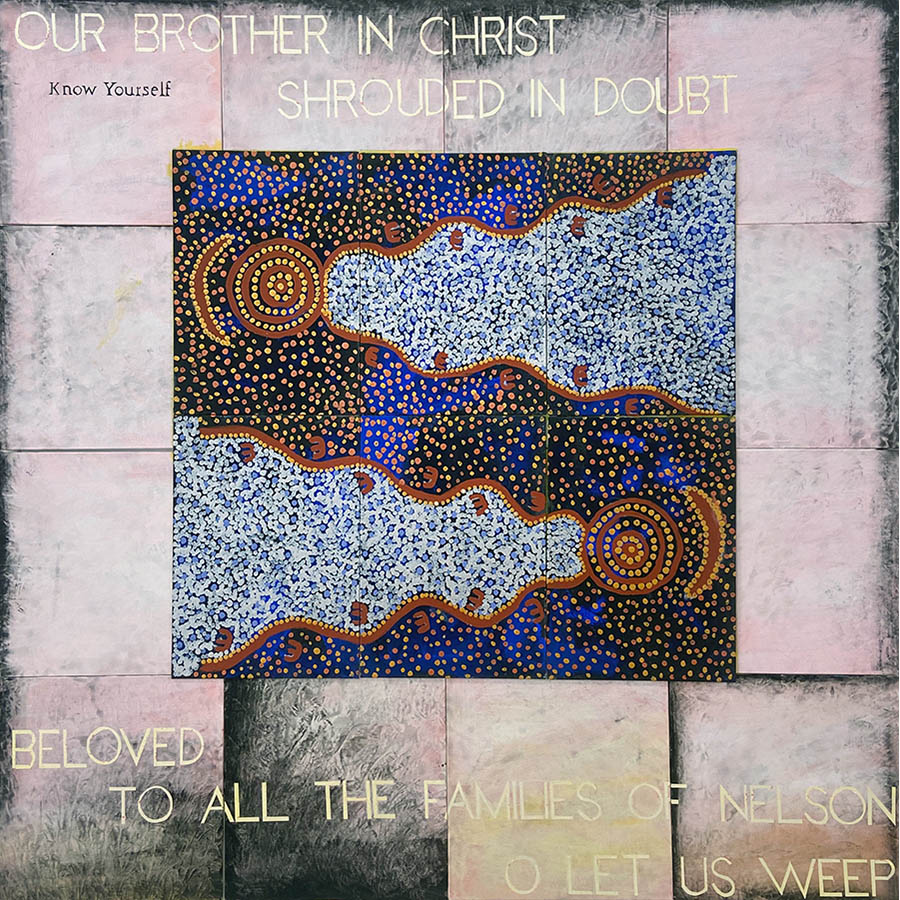
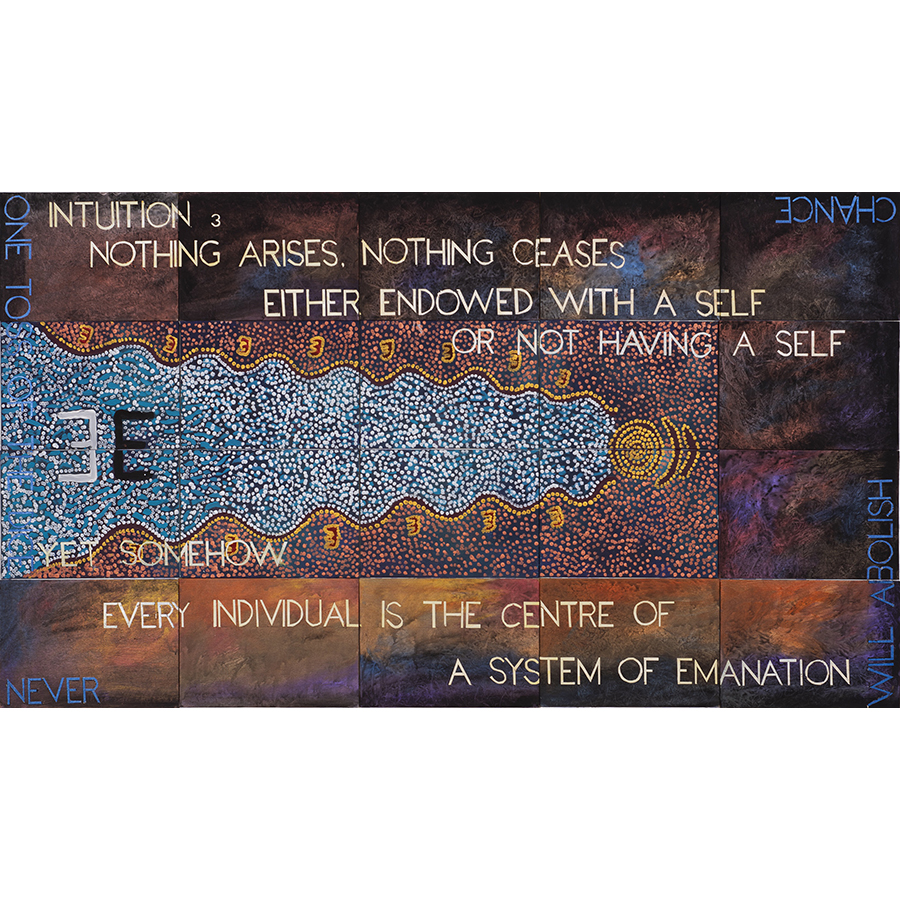
The exhibition Possum Stories showcases Jagamara’s various treatments of his Possum narratives painted between 2000 and 2019. All have the distinctive Possum track markings including the ‘E’ as footprint icon. Snaking tracks depict the macro and micro possum people travelling East and West, day and night. Providing some extra gravitas, this exhibition also includes five new and old collaborative works by Jagamara with Imants Tillers. These are yet more examples of their ‘auspicious entanglements’ that espouse connectivity and mystery. Jagamara and Tillers first collaborated directly from 2001, in Brisbane until Jagamara’s passing in 2020, completing over 25 works. Several additional works begun in 2019 were posthumously finished by Tillers in his Cooma studio between 2021 and 2026. In 2021, The Tate Modern London acquired a major collaborative work, The Call from Papunya, which featured Jagamara’s Possum Story as a central motif embedded within Tillers layered complimentary imagery and texts.
Two collaborative works begun in 2019, but not finished until 2024, are included in this show; namely Know Yourself and Intuition 3 (Image 4 & 5) alongside their very first collaborative work Nature speaks (with Confused Possum), 2001 (Image 6.). The two new works, will enjoy their first viewing in Australia having just returned from the exhibition Fierce Paradise: Conversations with Aboriginal Art, shown at Museum im Schafstall Neuenstadt am Kocher, Baden Württemberg, Germany, curated by Hubert Sawatzki and Isidore Tillers.
In one of the fascinating exhibition catalogue essays, The Painter Who Loves Books: Imants Tillers, by Ian Maclean, he cites the Possum Story as integral to the artists union:
Tillers’ attention was first caught by the Possum Dreaming Men of Mawarriji, a Jukurrpa which belonged to Jagamara as it was his father’s and grandfather’s Country, for which Jagamara was the ritual boss (policeman or manager). It is famous across Central Australia for its archetypal Possum love stories about the dangers of ‘wrong skin’ (taboo) relationships, of ‘love, transgression, retribution and death’, as Vivien Johnson put it. Did Jagamara believe his relationship with Tillers was a ‘wrong skin’ Possum Dreaming story? Is this why he made the Possum story the subject of their first few collaborations? Is Jagamara’s first painting when he and Tillers started their collaborations, which he called ‘Confused Possum’, a direct reference to Tillers? (Image 6)
I would like to thank and acknowledge all the contributors to the exhibition, Possum Stories, which pays tribute to Michael Nelson Jagamara and family. Special thanks to Imants Tillers, Isidore Tillers, Djon Mundine, Ian McLean, Euan Carlisle and Una Rey.
Michael Eather, FireWorks Gallery Brisbane, September 2026